
A Pathway to Passive House Compliant Products for Multi-Family Construction
Passive House has quickly become the go-to route for compliance in multi-family construction in Massachusetts and is gaining traction across New England as energy codes are updated and adopted. In Massachusetts, 95% of the city/towns have adopted Stretch and Specialized “Opt-In” codes which drive many multifamily (Group-R) projects into Passive House compliance.
And while Passive House may appear daunting, the reality is it is fairly straightforward: On Passive House projects, the construction team will include working with a Certified Passive House Consultant/Designer and a Passive House Verifier that evaluates the HVAC design to ensure it aligns with the energy model. The certification process requires independent, HVI-certified performance data, eliminating the risk of specifying equipment that doesn’t perform as cataloged.
If you schedule equipment that meets the energy model and can be verified, your engineering work up front becomes the bulk of the effort. Buckley is here to make that part easy.
We have developed and delivered actual schedules MEP Engineers can specify on projects today.

Small ERVs: From the Wild West to Verified Performance
For years, choosing a commodity ERV was straightforward:
- performance data wasn’t independently validated
- products weren’t required to meet their published ratings
Today, Passive House standards mandate the use of HVI‑Certified performance data. It’s important to consider how these units are scheduled. Buckley offers a pre-qualified equipment schedule that meets typical Passive House verification criteria.
- Sensible Recovery Efficiency (SRE) must typically hit ≥ ~80% at design airflow.
- Efficacy must be ≥ ~2.0 CFM/W (or equivalently low W/CFM)
- Total Watts matter, as they directly feed the energy model.
Buckley Small ERV Solutions
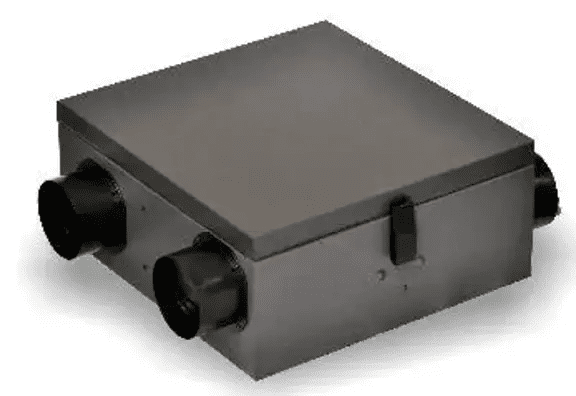
Reversomatic RERV-130ECM
- Outstanding SRE: 87% @ 64 CFM, 85% @ 95 CFM, 82% @ 136 CFM
- Efficacy: 2.0 CFM/W across all airflows
- Best option for ≥64 CFM design flow
- Incredible HVI Data up to 136 CFM. Perfect for Passive House
- Price point is highly competitive—this is the “workhorse” small ERV
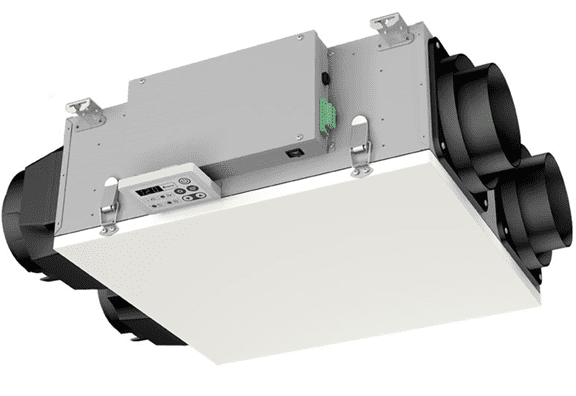
DeltaBreez VEB-165S
- Exceptional Low-Flow SRE: 90% @ 36 CFM, 84% @ 64 CFM, 75% @ 127 CFM
- Efficacy: ~2.37 CFM/W @ 64 CFM, stays near 2.0 CFM/W across range
- Ideal for <64 CFM designs
- Verified HVI data and readily modelable for Passive House
- Another Cost-competitive alternative Small ERV
Other Important Equipment
On Passive House projects, the ERV duct system is typically independent of the in-unit fan coil or HVAC system, resulting in a dedicated intake and exhaust with ventilation air supplied directly to the apartment. Under winter design conditions, this can result in post-ERV supply air temperatures as low as ~50°F. To address this, a small electric duct heater should be shown downstream of the ERV, along with a dedicated intake/exhaust combination wall box. Both items should be included on the drawings for Passive House applications.
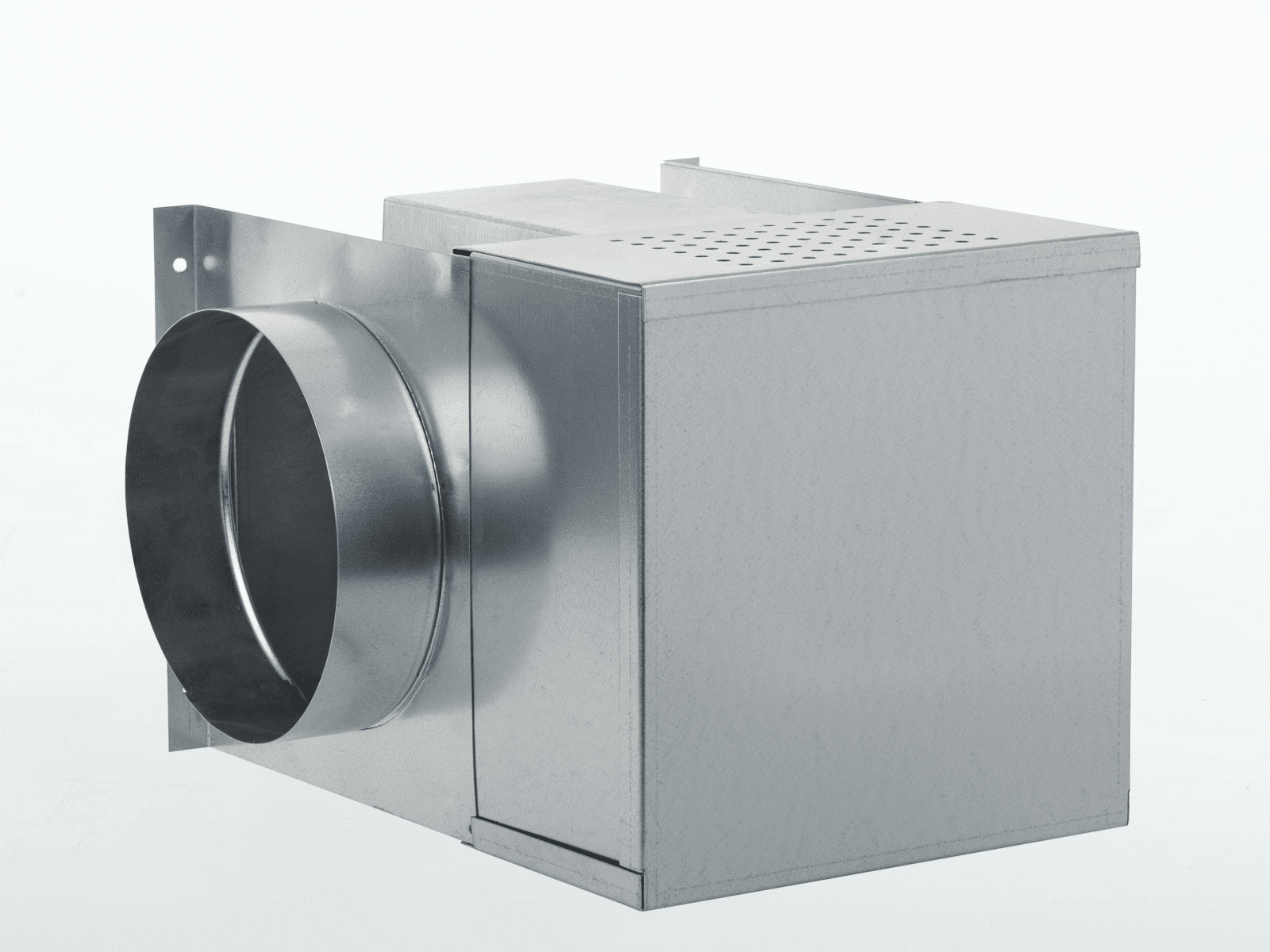
Downstream ERV Duct Heaters – Thermolec TER
- 5″ or 6″ round electric duct heater built to meet capacity specified between 0.5-2.0 kW.
- SCR Controller allows 10% of maximum capacity meaning a 0.5kW could operate at 0.05kW
- Electronic Airflow Sensor will engage electric heater as low as 50fpm (or 30 cfm)
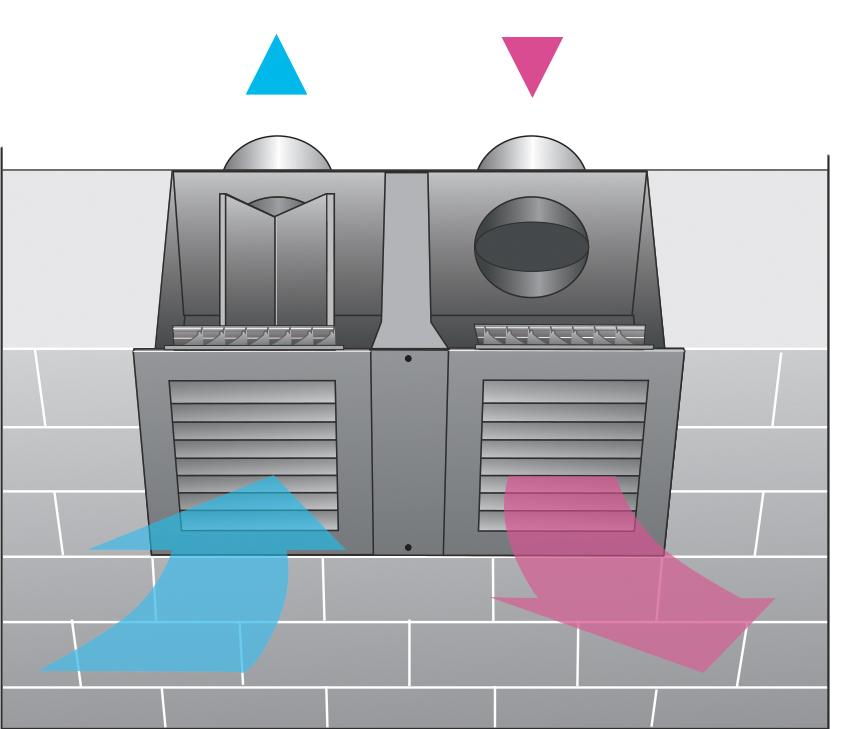
Intake & Exhaust Combo Wall Boxes – Reversomatic DVG
- IMC 2021 Section 4 says, “Separation is not required between intake air openings and living space exhaust air openings…”
- Save space with one exterior wall penetration
- Flush-face louvered intake/exhaust offers architectural finish
- Lab-tested for recirculation
Centralized Passive House Strategy
As an alternative to apartment-level ERVs, many MEP engineers pursue a centralized HVAC strategy for multifamily residential projects. This approach utilizes a high-efficiency DOAS unit with centralized supply and exhaust risers, paired with Aldes CAR3 constant airflow regulators installed in Zone Register Terminals (ZRTs) to maintain code-required minimum and maximum airflows at the apartment level. SystemAir DOAS units are Passive House-Certified Components and are well suited for centralized Passive House applications.
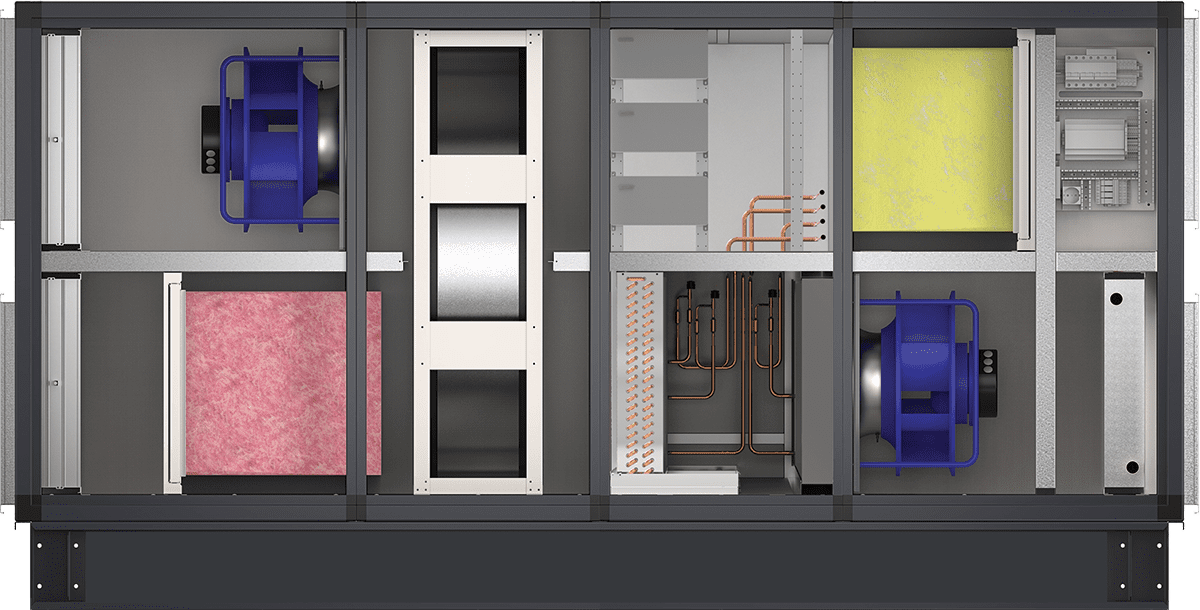
Systemair Geniox DOAS
- 400–65,000 CFM range
- Passive House-Certified (up to 10,000 CFM)
- 80–85% effectiveness with AHRI 1060 data—ideal for Passive House
- Designed for seamless integration with any 3rd-party VRF (though Buckley recommends Fujitsu VRF)
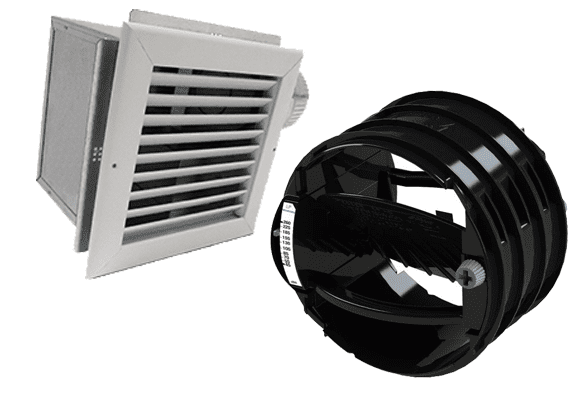
Aldes CAR3 & ZRT
- Constant Airflow Regulators(CAR3) maintains consistent, code-compliant max/min ventilation airflow
- Zone Register Terminal (ZRT) provides dual CFM setpoints triggered by local control
- ZRT available in inline, room facing, and fire-rated configurations
Contact Us Today
Need assistance with a specific application and don’t know where to turn? Our team of technical engineers can assist you in applying the appropriate product for your application.